Tuesday, 31 December 2013

Mean girls


Mean girls is about a  girl who moves to the US from Africa and starts at a new school. She immediately befriends two outcasts, who explain the school's social scene. There are a group of three girls (the Plastics) who are popular, mean and rule the school. On a lark, these three girls befriend Lindsey Lohan. Her outcast friends encourage her to hang out with the Plastics to see what they do. But as she spends more time with them, she becomes more and more like them, backstabbing, mean, self obsessed, and superficial.
When Lindsey Lohan and the leader of the Plastics go after the same guy, she begins to plot their destruction, and starts sabotaging the girls in worse and worse ways. Eventually she alienates her original friends and her Plastic friends. When the entire school finds out about some of the terrible things the Plastics have said about them by finding a "Burn Book" everyone turns against the Plastics and Lindsey Lohan.
Eventually, she must apologize to everyone she hurt and begin to find a way to become a better person.
 
Themes:
  • Love
  • Location (High School)
  • Music: (Young and relates to girls)
  • The characters: protagonist characters are all teens so relates a lot to teenagers
  • Feminism
 
Stereotypes are represented throughout the film. Stereotypes is a widely held but fixed and oversimplified image or idea of a particular type of person or thing. such as the 'dumb blonde'. One of the girls are called Karen (Blonde) where she makes ridiculous and diabolical statements throughout the film shown as brainless by stating that she could check the weather with her breast. There are many other  different cliques you see: “the Plastics” the most popular girls; “the Jocks” this is the most popular boy that every girl desires to be with and the “nerds” which is stereotyping all the clever pupils. However this stereotype is challenged because being clever doesn't necessarily mean you are a nerd, this is shown as Cady who turns out to be popular is actually really smart and gets top grades.


Sunday, 29 December 2013

Superbad

Superbad

I recently watched the teen comedy 'Superbad'. The plot follows three friends, (Jonah Hill, Michael Cera and Christopher Mintz-Plasse), who are labeled as unpopular within their school's social standing. However, they are given a chance to move up in the hierarchy and possibly lose their virginities when they are invited to a party. But they are required to bring alcohol with them in order to be able attend, and they are all underage. 
Superbad Poster.png


 Characters
   
Seth (Jonah Hill) is one of the main protagonists of the film. He is considered as unpopular in his school's hierarchy and is out of shape, and therefore not popular with the females in the school either. In addition to this, he only has two friends: Evan and Fogell, whom he often drinks with in order to get 'wasted'. He is desperate to lose his virginity before attending college and saw the party as his last opportunity to do so. He also conforms to the stereotype of teenage boys being willing to go to great lengths for sex, as he planned to get Jules drunk and have sex with her at the party.

Evan (Michael Cera) is Seth's best friend and is also one of the film's main protagonists. He is also unpopular and is categorised as a nerd in the school's social standings. His nerdiness is reflected through the mise en scene that is used to portray him. For example, his costumes are neat and lack style. In addition to this, many of his tops have a collar, which highlights his high level of sophistication even when he is at a party. The colours of his costumes are also dark, which implies that he is content with being in the background and not having attention on him. He is different to Seth because he won't take advantage of females; as demonstrated when he refuses to have sex with Becky when she is drunk, despite being aroused. With this he challenges the stereotype of all teenage boys being sex-crazed and shows that he is morally aware.

Juels (Emma Stone) is a pretty, popular girl that asks Seth to buy her alcohol for the party that she is having at her house later in the day. She differs from the stereotypical popular girl in other films as she is humble and doesn't consider herself to be better than anyone else. This is proved by the fact that she is able to have genuine conversations with unpopular people like Seth, and even invites him to her party. Another way in which she is different from the typical popular girl is that she doesn't conform to peer pressure, which is demonstrated by the fact that she is having a party, even though she doesn't drink alcohol.
Fogell (Christopher Mintz-Plasse) is also one of the protagonists in the film and is somewhat a fifth wheel regarding his relationship with Seth and Evan, as demonstrated when they were reluctant to tell him about the party until he told them that he was getting a fake id. Of all the protagonists, he represents the nerd stereotype the most, the glasses were the main giveaway of this. Furthermore, his clothing and awkwardness when talking to females also emphasise his nerdiness. In contrast to his undesirable features, he is the only one of the trio that uses slang in order to try and sound cool, for instance 'gangsta's, what's up guys?' This implies that he is not satisfied with his low position in the school's hierarchy and that he is trying to be something that he us not. However, despite these factors, he was the only one of the three to have sex at the party, which challenges conventions of nerds being undesriable.


Saturday, 28 December 2013

21 jump street

21 jump street: this film has a predominately male audience. Many teenage boys aspire to experience the action that the characters experienced.

Tuesday, 17 December 2013

Representation task: identification of stereotypes in teen films.

NOT ANOTHER TEEN MOVIE


films that this movie parodied:

  • 10 Things I Hate About You
  • Almost Famous
  • American Beauty
  • American Pie
  • Better Off Dead
  • The Breakfast Club
  • Bring It On
  • Can't Hardly Wait
  • Cruel Intentions
  • Dazed and Confused
  • Election
  • Ferris Bueller's Day Off


  • Grease
  • The Karate Kid
  • Lucas
  • Never Been Kissed
  • Pretty in Pink
  • Risky Business
  • Road Trip
  • Rudy
  • Save the Last Dance
  • She's All That
  • Sixteen Candles
  • Varsity Blues
  • Summer Catch
The producers of the film 'Not another teen movie' 
decided to use intertextuality in order to enhance the comedy aspect 
\of the movie, also the use of intertextuality makes the film relatable as it includes 
the same ideas and stereotypes that occur in these  popular teen movies.

definition of stereotypes: 
A stereotype is a widely held  but fixed and oversimplified image or idea of  particular type of person, thing or group.


This is a classic example of stereotype from the well-known British drama 'kidulthood'.


Here are some images which encapsulates some hilarious moments in the film:


Within plenty teen movies there are always stereotypes about different
 groups of students in 'high schools'. some of the main grow identified in these movies are the jocks, 
cheerleaders, geeks,the cocky students, mean girls etc. These cliques are what 
define students and their personalities in these films, in order to conform with 
their clique they adopt a certain attitude in order to represent their groups.

This is the Trailor of the film (MUST WATCH)


Representations and stereotypes in teen films

Not Another Teen Movie Stereotypes


Stereotype: an oversimplified and standardised conception or image invested with special meaning and held in common by members of a group.


From the opening of the film, we are provided with three stereotypes that occur. These include: the jocks, the nerds and the cheerleaders. These stereotypes are conveyed by methods like the mise en scene that is used to portray certain social groups. For example, the jocks were wearing their football teams jersey in order to highlight their status as an athlete. Not another teen movie also uses intertextuality to reference teen films before it to add to its narrative. This bolsters the aspect of comedy in the film, granted the audience has hindsight to the characters that it referenced. For instance, at the end of the film when Jake is trying to convince Janey not to go to Paris, he uses an abundance of lines from other films such as: American Pie, The Breakfast Club and Pretty in Pink to convince her to stay. This mocks clichés that commonly feature in other teen films and implies that it is an aspect that occurs too frequently, despite the fact that the film itself had to conform to the norm in order too prove their point.   


  An example of a reference to a cliché that features in many films that were made before.

                               
           Representations and stereotypes


One of the most common stereotypes that feature in  school based teen films are the jocks. They are athletic and usually represent their school in various sports such as American football, football (often referred to as soccer due to the American culture) or basketball. Because of their sportiness, they usually wear their teams jersey at school to reflect their status. They are at the top of the school hierarchy and because of this girls tend to be attracted to them. In addition to this, they use physical force to bully people that are near the bottom of the hierarchy like nerds in order to display their supreme authority.  

Another common stereotype that is portrayed in many teem films is the nerd. They usually dress in formal, uncool attire and are only accepted by other nerds. They can be any gender and are often intelligent, however, they are also bullied by other social groups within the school system such as the jocks or cheerleaders. More often than not, they abide by the 'brains over brawn' saying and are therefore either scrawny or husky. Facial features such as acne and props like glasses and braces usually allude to someone's nerdiness in teen film.

The cheerleader is another stereotype that is bound to appear in school based teen films. They are pretty, popular and usually have relationships with jocks. Their costumes are usually vivid and eye-catching to ensure that they get as much attention as possible. Like the jocks, they are at the top of the hierarchy of the school and they feel that it is okay to treat others that aren't as popular as them as they please. They aren't particularly intelligent and often get jealous about anyone that they see as competition for attention, spreading rumours is an example of a method that they may use to dispel this opposition   

representation & stereotypes

Stereotypes are widely held but fixed and oversimplified images or ideas of a particular type of person or thing.

There are many stereotypes involved in 'not another teen movie'. One stereotype is the jock who is the coolest and popular guy in school who everybody loves. The 'pretty ugly girl is a girl who is very pretty but doesn't appear attractive because of the way she dresses or acts. The  'token black guy' is basically a black guy who appears out of nowhere when an event happens in school and comments saying stuff like "damn". Another stereotypical teen is the 'nerd' who hangs around other nerds, some of which can be classified as the 'desperate virgin' as most dream about having sex or going out with the 'perfect girl'.

Not another teen movie has adopted other stereotypes from other teen movies and combined them all into one film. This is called intertextuality. For example they used 'Danny Zuko' from Grease to create their own jock and use ideas from him onto their jock. 


Not another teen movie stereotypes their characters in many ways. One of them is props; for example the 'pretty ugly girl girl' character will be a pretty girl however she will wear glasses and be covered in clothes to make her look less appealing to the male gaze. Jocks will wear a baseball jacket which will make them stand out as only the 'jocks' can wear it… its not part of everyones dress code it's only made for them. Another way is non-diagetic sound. Nerds will speak very formative and use geeky language such as 'super' etc; jocks will be very cheeky and confident in front of girls complementing them on how they look.


Monday, 16 December 2013

Holiday Task - write an analysis of a teen film you have watched

Boyz n the Hood (Analysis)


Boyz n the Hood


Boyz n the hood is a powerful hood drama distributed by Columbia Pictures in 1991, it was written and directed by John Singleton. The movie addresses the situations of those growing up the hood, throughout the movie they show that most are exposed to violent crime, drugs, temptation, and even unjust harassment by the police. The movie was primarily aimed at young African American males, this is confirmed by the message displayed at the beginning of the film.


Through the 3 main characters Trey, Dough boy and Ricky the director helps to represent the average black male growing up in the hood.


Trey (Cuba Gooding Jr.)


Trey is moved to go and live with his dad (played by Laurence Fishburne) when his mother (played by Angela Bassett) grows tired of him constantly acting up in school, in her doing this she not only puts him on the road to become a man but also subjects him to the danger of his environment.His character is set up as an almost "neutral" party as he represents the constant struggle between good and evil in a child as a result of their surroundings, Dough boy being the "evil" and Ricky being the "good".


This is also shown when they are children, the camera frames the three of them so Trey is in the middle while the two brothers Dough boy and Ricky are fighting behind him. This further shows that throughout the movie he is constantly tempted to follow his friends despite the ramifications.


Ricky (Morris Chestnut)


Ricky represents the person trying to be productive with his life and get out of the hood. He is a teen father and is looking to go to college on a football scholarship. He is unsuccessful in the matter as he shot by local youths as result of a prior disagreement.


This was one of the most unfortunate and memorable deaths in the history of film, Ricky wasn't a gang member or delinquent but simple a teen father trying to make a life for himself and make sure he can provide a good life for his son. I talk about him as if he is a real person, because for many of the intended audience this was a real person as they may have known someone like this.

Dough Boy (Ice Cube)


Dough Boy however shows the person who is a clear product of his surroundings and has submitted to its ways of life, he is put on the path to crime at the tender age of 10. Some may argue that the absence of a father/ father figure in his life has resulted this to happen, it may also be because of Ricky being the apparent favourite child, it is implied that the "favorite" may be because of their different fathers. Dough Boy's mum (played by Tyra Ferrell) seems to be less affectionate towards him than Ricky through her actions in the movie. She would speak in gentle, loving tones to Ricky but speak harshly towards Dough Boy. When they both were fighting she walks over to them and slaps Dough Boy then turns around and comforts Ricky. This type of behaviour may have caused him to feels inadequate and so act out.

Through the presence of these characters they connect with their target audience, because they are relatable and are carried out realistically and with such passion. On some level this also connects with those outside of their audience as the chosen themes cover a wide perspective.


Saturday, 14 December 2013

The Bling Ring


Teen movies definition:
Teen films is a film genre
 targeted at teenagers and
 young adults in which the
plot is based upon the special
interests of teenagers, such as
 coming of age, first love, rebellion,
conflict with parents, teen angst or
 alienation etc.

The  bling ring summary:
this movie is based on a true story where a new kid in town befriends a fame obsessed girl who eventually persuades him to help her get into his friends house as he is out of town. Eventually after breaking into Paris Hiltons house the first time and stealing a few things, her other peers get involved  in these heists of famous peoples belongings becomes a normality amongst friends as they are so infatuated with fame and the high life. 


Characters:


  • Israel Broussard- As Marc Hall
  • Katie Chang-As Rebecca
  • Taissa Farmiga- As Sam
  • Claire Julien-As Chloe
  • Emma Watson-As Nicki
  • Leslie Mann-As Laurie 


Within the film a number of themes
 were publicised, ones such as:
  • CRIME
  • RELATIONSHIPS
  • DRUGS/ALCHOHOL
  • MONEY
  • CELEBRITIES
  • FASHION
  • GREED
  • MUSIC
  • PARTYING 
Just like any other film, location is very important, within this movie
a range of different locations are used throughout for example:
  • Bedrooms
  • Clubs
  • Celebrities houses
  • friends homes
in comparison to other teen movies this film differs in the sense that
true friendships are at naught by the end of the movie as they are portrayed
as users due to the fact that they were all willing to blame each other in order
to save themselves, whereas in other teen movies the friendship groups are
generally really tight knit and genuine. However, 'The bling ring' does link with
other teen films as a clique is clearly present in the movie although it is just one being
shown it is easy to tell that through their actions and behaviours, they belong to a certain group
of people. Cliques consist of a group of people who have the same passions and interests and this is clearly shown through these actors.

TRAILER FOR-'The bling ring' 


The Bling Ring


The Bling Ring is a teen drama based on real life events. It follows the lives of a group of teenage friends that burgled many celebrity homes around California throughout the duration of several months. It is a teen drama because the main characters go to high school, which is one of the main locations in the film, and many conventions that are used stem from this aspect.

Some of the main conventions that are used in the film include:

Relationships


In The Bling Ring, relationships for the main characters are complex. The main protagonist, Marc, secretly admires his best friend: Rebecca. This combined with the fact that she was his only friend at the time resulted in him being willing to participate in burglary and theft to maintain their relationship. This suggests that nowadays teens will go to extreme measures just to be accepted and have friends. However, the darker side of friendships is also demonstrated in the film. For example, when they were caught stealing they all turned on each other and were willing to let others pay the price instead of owning up to their misdeeds. 

Partying


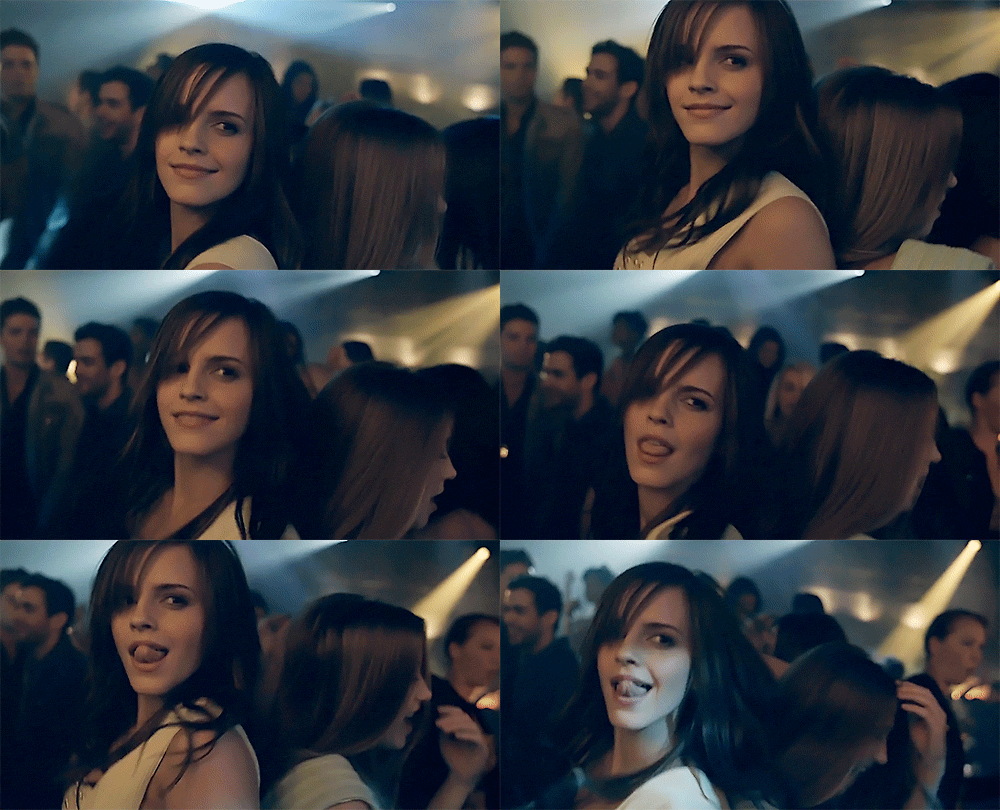
Throughout the film, the protagonists are frequently seen partying at various social establishments such as nightclubs. These places provided the teens with the audience to show off their stolen goods to, and through this people complimented them and gave them positive attention. This in turn fueled their will to continue stealing from celebrities. Despite the conventions of teens being addicting to partying in the film, the majority of the people at these functions are adults. Both this and the teenagers' determination to have a good time by participating as much  as they can suggests that they want to grow up to quickly. However, their failure to act like adults and own up to their crimes when they were caught shows that they are far from being respectable adults.

Fashion


Fashion is one of the main causes of the group's wrongdoings; they had to steal in order to obtain the most desirable clothing and accessories. It all stemmed from a combination of idolisation of celebrities like Paris Hilton and Lindsay Lohan and an urge to be liked and therefore accepted by people. It was as if stealing their clothes would result in them obtaining the same status as their rightful owners, and the positive comments from people regarding the stolen items encouraged them to continue stealing. In addition to this, the fact that they received an abundance of friend requests on social networks like facebook suggests that this generation of teens have warped morals when compared to older generations.


The bling ring

 There are many conventions used in the film which establishes it is teem drama such as: themes, location , music and more.
One of them is the themes. Themes such as relationship(difficulties of fitting in), drugs/alcohol-partying and the idolism of celebrities (fashion, money, cars and status)
Another aspect is the location. locations such as the high school, beach and family homes/celeb homes is iconic to where celebrities hang out and want to hang out.


Music is another reason why this is a teen drama because of the 'young' hip hop music.

The characters play a big role when deciding if this was a teen drama or not; the fact that the characters are teens themselves shows it's aimed at a teen audience. Also they play up to the stereotypical representation of teens that they are money obsessed and idol a lot of celebs. The adults are dumb and poor parents who gives excess freedom to the teenagers.

The partying, drugs and alcohol appeals to a teen audience as that's what society mainly associates and generalises teens at. The cars also are key props when establishing a teen drama as most teens dream to have cars featured in the movie.
Overall then bling ring appeals to a teen audience as it showcases how most teens want that 'hollywood, celeb' lifestyle.